
Chelsea are one of the most fascinating and difficult saves in Football Manager 2026.
On paper, the project looks almost perfect. An ownership group willing to spend aggressively, some of the best young talent in world football and a squad filled with high-upside players who could dominate European football for years.
The reality is far more complicated.
BlueCo’s strategy has created a squad overloaded with potential but short on balance, leadership and certainty. The pressure from the ownership model, the expectation of Chelsea supporters and the constant demand for immediate success make this one of the most intense rebuilds in Football Manager.
At Chelsea, simply qualifying for Europe is never enough. Fans expect major trophies, attacking football and a team that feels worthy of Stamford Bridge.
That creates the real challenge of this save.
This is not about buying more wonderkids or downloading an overpowered tactic. It is about bringing structure to chaos, creating a clear football identity and turning one of the most expensively assembled young squads in football history into a genuine elite side.
This Chelsea FM26 guide covers the squad, tactical setup, key players, transfer priorities and long-term save goals needed to rebuild Chelsea properly.

Chelsea FM26 Save Overview
Chelsea are not a traditional super-club save in Football Manager 2026.
Despite the transfer spending, elite facilities and huge reputation, this is not a ready-made title-winning squad. The challenge is not simply winning matches — it is creating cohesion from one of the largest and youngest squads in European football.
The club arrives in FM26 carrying the same questions that surround Chelsea in real life. How do you balance long-term development with immediate pressure? Which young players are genuine foundations and which are simply valuable assets? How do you create tactical stability when the squad has been built through aggressive recruitment rather than a single football vision?
That is what makes this save so compelling.
You inherit a squad capable of becoming one of the best teams in Europe within three or four seasons, but only if you can create structure, clarity and balance. Poor squad management can quickly lead to unhappy players, blocked development pathways and dressing room instability.
The expectation level is also enormous. Chelsea supporters will tolerate rebuilding phases far less than most clubs. Qualification for the Champions League should be the minimum expectation in season one, with a genuine Premier League challenge expected soon after.
This is not a save built around shortcuts or unrealistic transfers. The most satisfying Chelsea saves are the ones where you develop a genuine football identity, trust young players and slowly turn potential into dominance.
Chelsea FM26 Guide – Squad Strengths and Weaknesses
Chelsea’s biggest strength in FM26 is clearly the midfield.
The partnership between Moisés Caicedo and Enzo Fernández gives Chelsea one of the strongest foundations in the Premier League. Caicedo brings elite defensive coverage, athleticism and ball-winning ability, while Enzo provides control, progression and creativity from deeper areas.
Together, they allow Chelsea to dominate possession without becoming soft defensively. In a long-term save, that midfield partnership can become the core of an elite side for years.
There is also enormous attacking upside in the wider squad. Palmer is already a genuine world-class creator, while players like Estevão, Quenda and Kavuma-McQueen give Chelsea one of the highest potential ceilings in Football Manager 2026.
The weaknesses are more immediate.
Goalkeeper is probably the biggest issue in the squad. Robert Sánchez is capable of strong performances, but over a full Premier League season there are real concerns around consistency, distribution under pressure and reliability in big moments. Chelsea are aiming to become one of the best teams in Europe, and eventually the goalkeeper situation needs upgrading. Moving Sánchez or Jorgensen on is difficult in the first window. There is also the talented Mike Penders out on loan at Strasbourg.
Striker is another major question mark. João Pedro offers movement and technical quality, but there are legitimate concerns around whether Chelsea have a true elite-level goalscorer capable of delivering 30+ goals consistently in a title-winning side and Liam Delap lacks the quality to rely on him.
Centre-back can also become a problem, particularly with Levi Colwill unavailable for large parts of the first season through injury. Wesley Fofana has huge ability but also carries injury concerns, while the rest of the defensive unit lacks an established long-term leader in their prime years.
That creates the core challenge of the save.
The midfield and attacking talent give Chelsea an incredibly high ceiling, but the spine of the team still feels incomplete. The first few transfer windows should focus less on collecting more wonderkids and more on adding reliability, leadership and consistency to key areas of the squad.
Chelsea FM26 Guide – Tactics
Before building any tactic in Football Manager, it is important to understand that no system should ever be completely static.
The best tactics in FM26 are frameworks rather than cheat codes. Opposition quality, player condition, morale, fixture congestion and match context should all influence how aggressive or cautious you are from game to game.
This tactical setup should be viewed as a strong base for Chelsea rather than a “perfect tactic”. Small adjustments throughout the season are what turn good saves into elite long-term projects.
Chelsea are built to dominate central areas.
The Caicedo and Enzo partnership gives you the technical security and defensive stability needed to control possession, while Palmer provides the creativity and unpredictability in advanced areas.
Because of that, a 4-2-3-1 system feels like the most natural fit for the squad in FM26.
In Possession
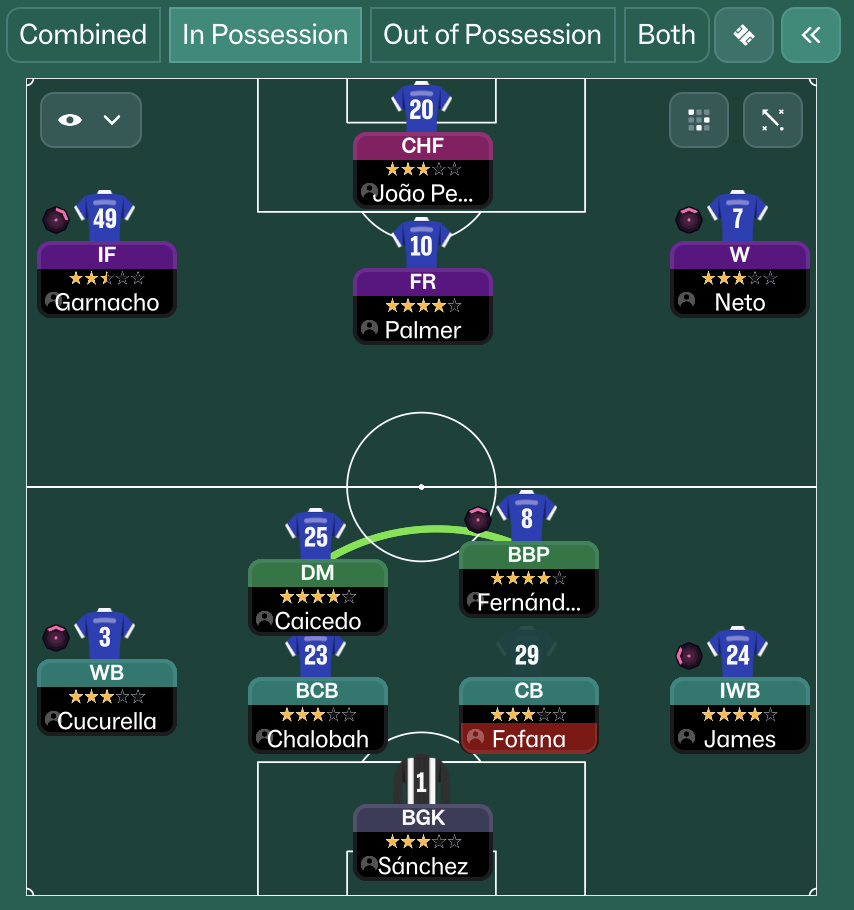
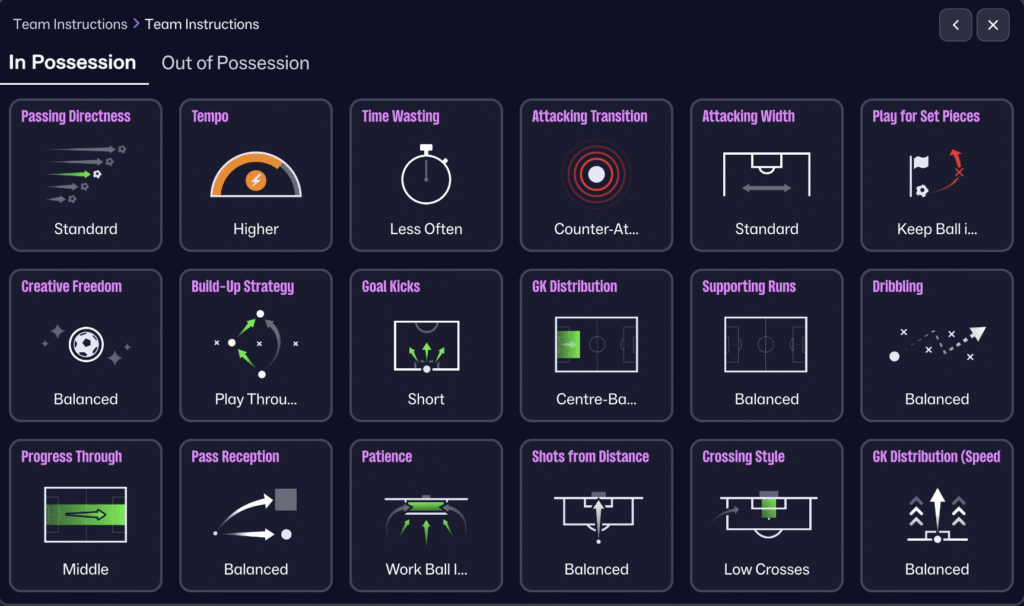
In possession, Chelsea should evolve into an aggressive but controlled 3-2-4-1 shape built around central overloads, positional rotations and quick technical combinations.
The system is designed to maximise Chelsea’s strongest area: midfield quality. Moisés Caicedo anchors the structure defensively while Enzo Fernández operates as the progressive connector between deeper build-up and the attacking unit ahead of him.
Reece James plays a crucial role in possession by inverting from right-back into central areas. This gives Chelsea additional control during build-up and helps create numerical superiority in midfield without sacrificing defensive stability completely. On the opposite side, Marc Cucurella provides the width and forward support needed to stretch the pitch vertically.
Further forward, Cole Palmer becomes the creative focal point of the system.
Rather than remaining fixed centrally, Palmer is given the freedom to drift into spaces between the opposition midfield and defensive lines. This allows him to combine with João Pedro, attack pockets of space and create overloads around the edge of the box.
The attacking structure around Palmer is deliberately asymmetrical.
Pedro Neto holds width more naturally on the right-hand side, helping stretch the opposition defensive line and create isolation opportunities in wider areas. On the opposite flank, Alejandro Garnacho attacks more aggressively from narrower positions, looking to drive into central channels and attack the box directly.
João Pedro’s role as a Channel Forward adds an important vertical threat to the system.
Rather than constantly dropping into midfield, Pedro looks to drift into wider channels, stretch centre-backs and attack spaces created by Palmer’s movement between the lines. This creates a far more dynamic attacking structure and prevents Chelsea becoming too static centrally during longer spells of possession.
His movement also complements Garnacho particularly well. As Garnacho attacks narrower inside channels from the left, Pedro’s willingness to move across the front line helps create rotations that are difficult for defensive lines to track consistently.
The role gives Chelsea more penetration without sacrificing technical quality in build-up.
The overall aim is not sterile possession for the sake of control.
Chelsea should circulate the ball quickly, dominate territory and create high-quality openings through movement and overloads rather than relying purely on crossing volume or transitional chaos.
The system also reflects the squad’s limitations.
Without a completely reliable goalkeeper or fully stable centre-back partnership, maintaining strong rest defence during attacks becomes critical. The deeper positioning of Caicedo alongside James’ inverted movement helps Chelsea stay compact enough to deal with counter-attacks if possession is lost.
Against deeper defensive blocks, the shape can become slightly wider to stretch compact opponents more effectively. Likewise, against elite opposition, reducing the attacking aggression of the full-backs can provide greater defensive balance over ninety minutes.
This should be viewed as a tactical framework rather than a fixed solution.
Out of Possession
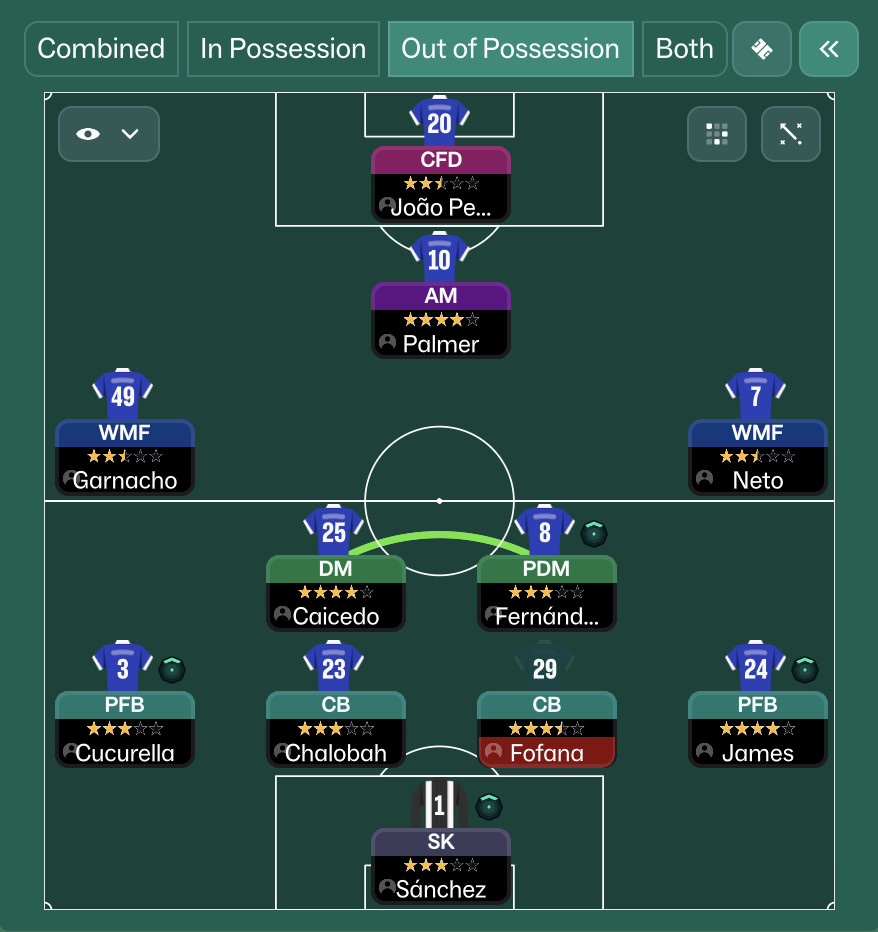
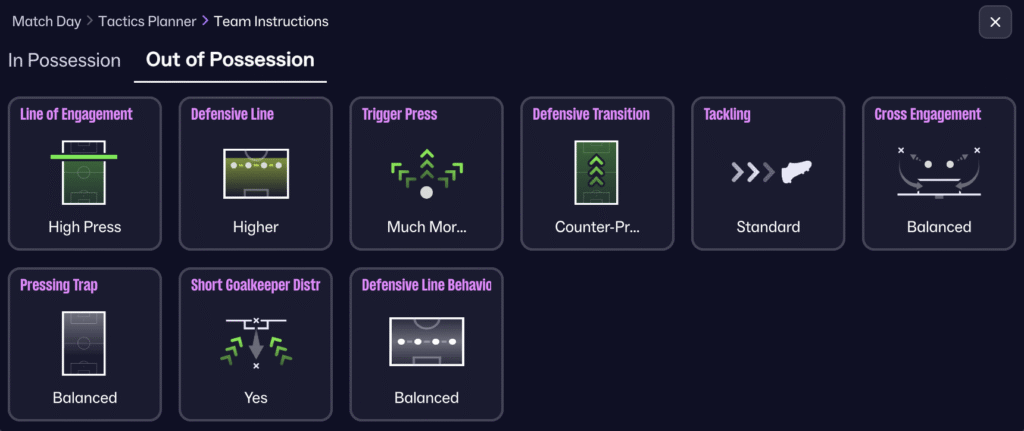
Without the ball, this system becomes far more compact and aggressive. Chelsea defend in what resembles a 4-2-3-1 mid-to-high press, with Palmer positioned underneath João Pedro ready to jump onto opposition midfielders and trigger the press centrally.
The aim is simple: force mistakes high up the pitch and immediately attack transitions before defensive structures can reset.
The higher defensive line compresses space between the midfield and defence, allowing Caicedo and Fernández to dominate central areas while preventing opponents from comfortably progressing through midfield.
Caicedo acts as the destroyer in the system. His mobility, anticipation and defensive aggression make him one of the best midfield ball winners in FM26, and the tactic is built around his ability to recover possession quickly and protect the defence during transitions.
The pressing structure also suits Garnacho and Neto. Neither player is elite defensively, but both possess the pace and work rate needed to press full-backs aggressively and recover into shape quickly when possession is lost.
The biggest risk within the system is the space behind the defensive line. Fofana’s recovery pace helps cover this somewhat, but against elite opposition or fast strikers the line can occasionally become vulnerable. Because of this, the tactic works best when Chelsea dominate territory and possession rather than defending deep for extended periods.
The counter-press instruction is critical to the system. Instead of retreating immediately after losing the ball, Chelsea attempt to swarm the area around possession and regain control quickly. This helps maintain territorial dominance and prevents opponents from launching direct counters into open space.
Importantly, this defensive structure should not be treated as completely rigid. Against stronger sides, lowering the defensive line slightly or reducing the intensity of the press can make the system far more stable over a full season.
Like most elite modern systems, the tactic works best when adapted to the context of the match rather than used identically every single game.
Chelsea FM26 Guide – Key Players To Build Around – Now and in the Future
Reece James
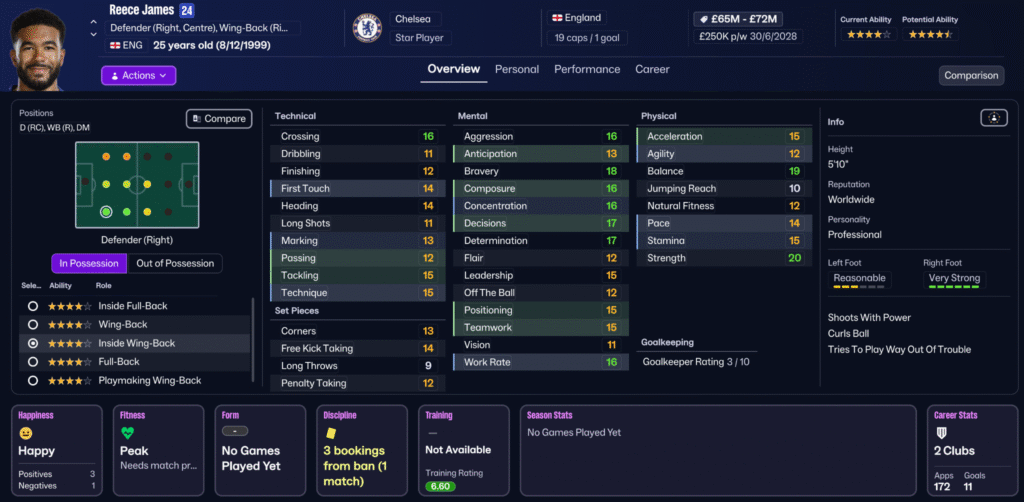
When fit, Reece James is still one of the most complete players in Football Manager.
His technical quality, physicality and intelligence allow him to completely transform Chelsea’s tactical structure both in and out of possession. While many right-backs simply provide width, James can operate almost like an additional midfielder during build-up.
His composure, decision making and defensive ability make him ideal for the inverted role used in this system. Rather than constantly overlapping, James steps inside to help control central spaces alongside Caicedo and Fernández.
What makes James so valuable is his versatility.
He can operate as a traditional full-back, an inverted wing-back or even as a centre-back in a back three depending on the tactical situation. That flexibility becomes incredibly important over a long FM save where injuries, fixture congestion and tactical tweaks constantly evolve.
The only real concern is availability.
Managing James’ minutes carefully is essential if you want to maximise his impact across an entire season.
Cole Palmer
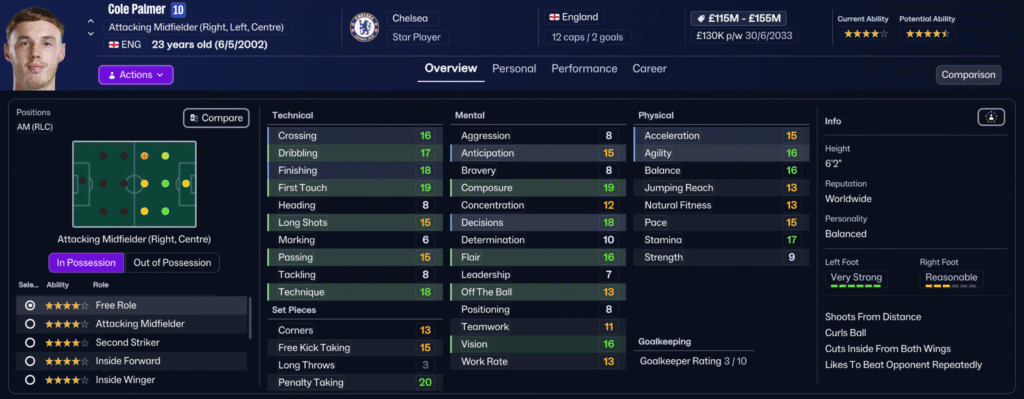
Cole Palmer is the superstar of the save.
Chelsea’s tactical system should ultimately be built around maximising his influence between the lines and around the penalty area. His composure, flair, technique and decision making make him one of the most dangerous attacking players in the Premier League from the very start of the game.
Palmer thrives when given freedom.
Rather than locking him into rigid positional responsibilities, allowing him to drift centrally and attack spaces naturally creates far more unpredictable attacking patterns.
His ability to both create and score goals makes him incredibly difficult for opposition systems to contain consistently.
As the save progresses, Palmer has genuine Ballon d’Or level potential if developed correctly and surrounded with the right tactical structure.
Moisés Caicedo
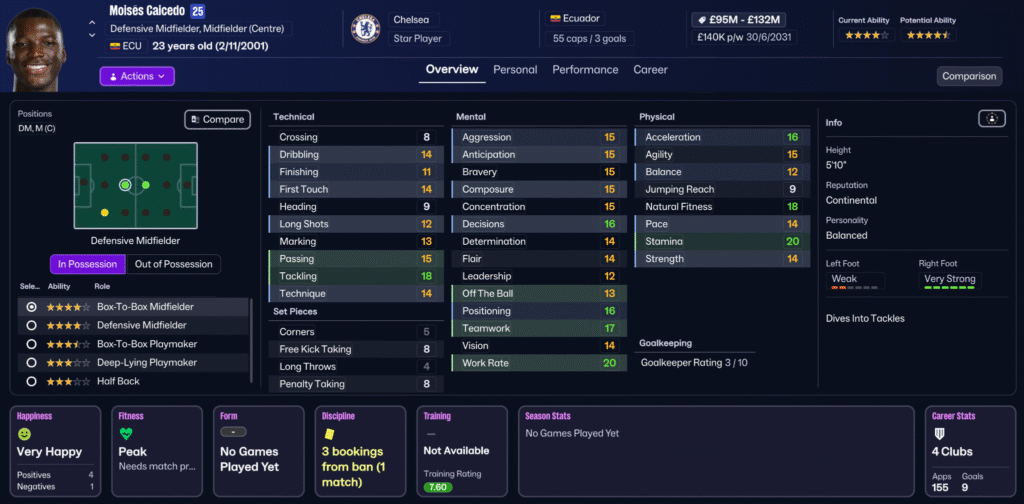
Moisés Caicedo is arguably Chelsea’s most important player in FM26.
Everything about this squad becomes more stable when he is on the pitch. His anticipation, tackling, stamina and work rate allow Chelsea to press aggressively without constantly exposing the defence behind him.
Caicedo’s role is not simply about winning the ball back.
He provides balance to the entire tactical structure. His positioning allows Fernández greater creative freedom while also covering the spaces left behind by aggressive attacking movements from James and Palmer.
Few midfielders in FM26 combine defensive aggression and technical security as effectively as Caicedo.
He is the player that allows Chelsea to play proactive football without completely losing control during transitions.
Ones for the Future
Mike Penders
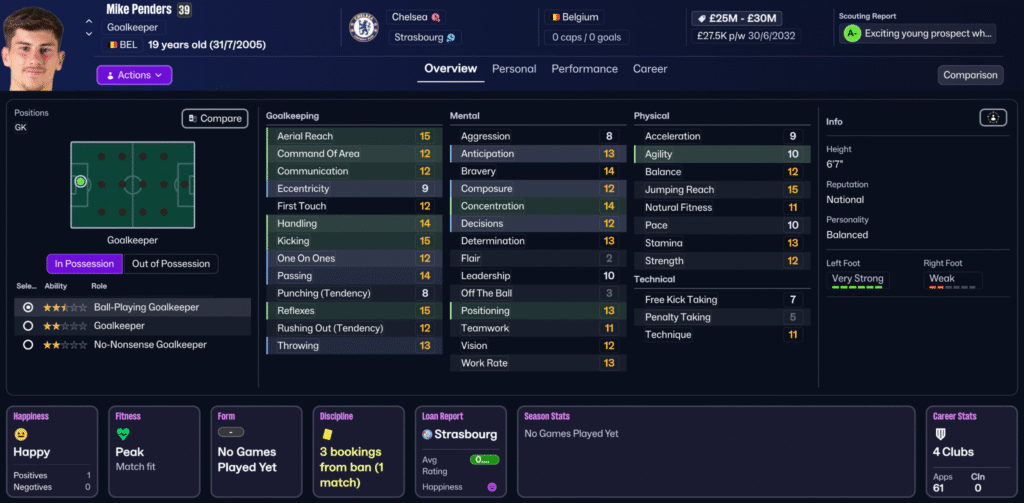
Chelsea’s current goalkeeping situation lacks long-term certainty, but Mike Penders could eventually solve that problem.
While he is not ready to immediately become Chelsea’s number one, his physical profile and reflexes give him huge developmental upside over a longer save.
Patience is important here.
Giving Penders consistent minutes through loans or cup appearances can accelerate his development significantly. By years two or three, he has the potential to become one of the strongest goalkeepers in the league.
For long-term saves, he is absolutely worth investing time into.
Ryan Kavuma-McQueen
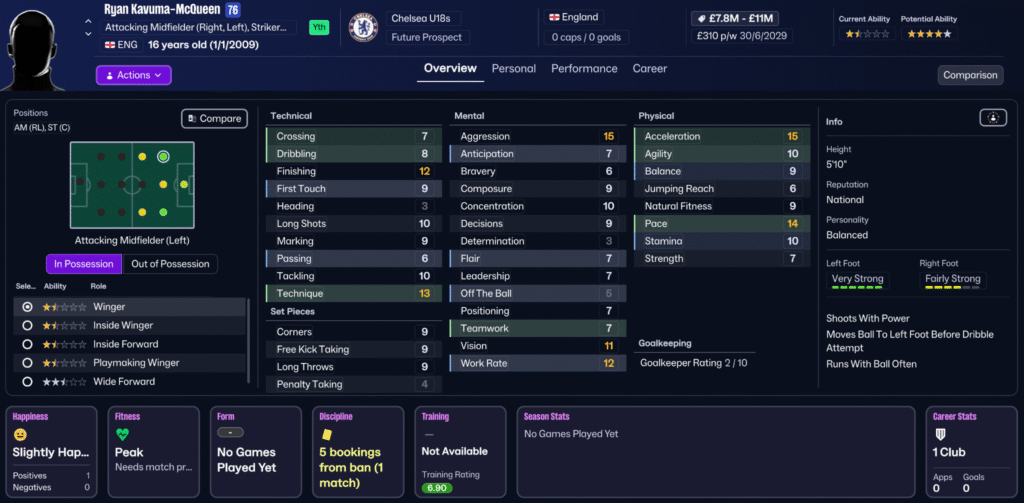
Ryan Kavuma-McQueen is one of the most exciting attacking prospects in Chelsea’s academy system.
His pace, directness and attacking instincts immediately stand out for such a young player. While his technical game still needs development, the raw athletic profile gives him extremely high upside if managed correctly.
He looks best suited to aggressive attacking roles where he can isolate defenders and attack space directly.
The key with Kavuma-McQueen is gradual development. Throwing him into first-team football too early could damage confidence, but carefully managed substitute appearances and youth development can turn him into a serious Premier League level attacker over time.
Reggie Walsh
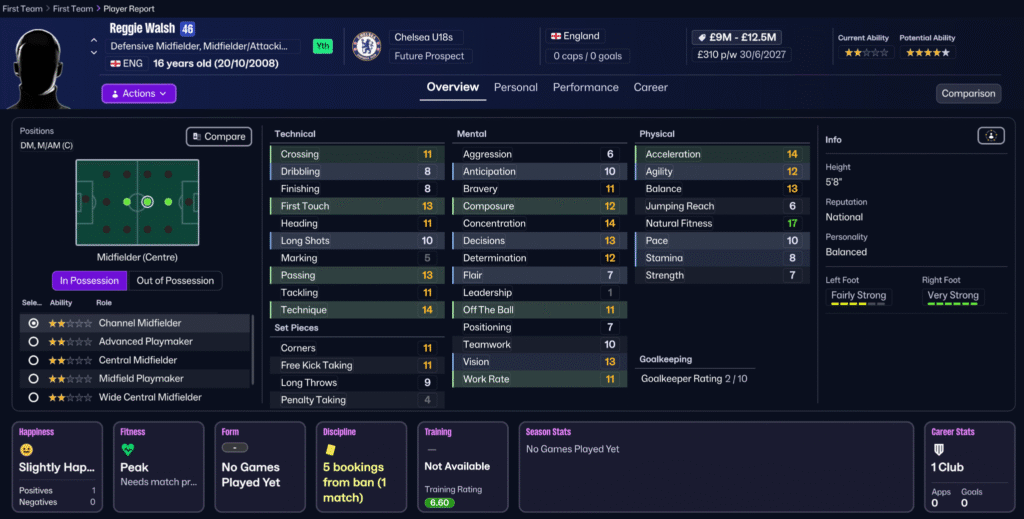
Reggie Walsh represents the type of technically intelligent midfielder Chelsea have increasingly tried to develop under the BlueCo structure.
His passing, composure and technical attributes already hint at a player capable of operating comfortably within possession-heavy systems.
Unlike more explosive wonderkids, Walsh’s development will likely depend heavily on physical growth and tactical education rather than raw athleticism.
If developed patiently, he has the potential to become an excellent rotational midfield option capable of fitting naturally into possession-based systems built around technical control.
Chelsea FM26 Guide – Players To Sell or Move On
One of the biggest challenges in a Chelsea FM26 save is squad management.
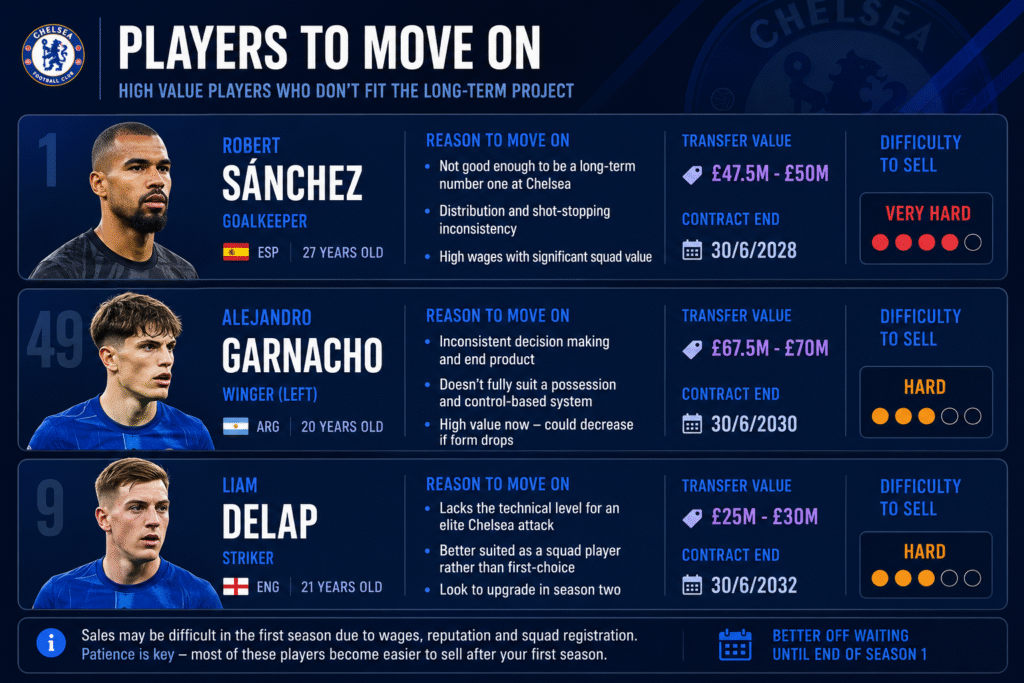
Chelsea begin the game with an enormous squad, huge wage commitments and several players who are difficult to move on immediately. Because of this, trying to completely rebuild the squad during the first transfer window can often create more problems than it solves.
In many cases, patience is the smarter approach.
Several players become significantly easier to sell after the first season once reputation, form, loan performances and AI squad building begin to shift naturally. For players aiming for a more realistic Chelsea save, season one should be viewed more as a stabilisation year rather than a complete reset.
The goalkeeping department is the clearest long-term issue.
Robert Sánchez and Filip Jörgensen are both serviceable options on Football Manager, but neither truly feels like the elite long-term solution required for a title-winning side. Unfortunately, both players can be surprisingly difficult to move on during the opening season due to wages, reputation and limited market interest.
Because of this, many saves will require temporarily both goalkeepers before targeting a genuine long-term number one later in the rebuild.
There is also an interesting balance between realism and pure Football Manager optimisation.
Players like Alejandro Garnacho and Jamie Gittens can become extremely effective within the game engine because of their athleticism and attacking profiles. However, some managers may choose to move them on in favour of more realistic long-term squad building or tactical balance.
The problem is timing.
Both players are extremely difficult to sell immediately in season one without heavily compromising value. Waiting until later windows usually creates far better offers and squad flexibility.
Liam Delap falls into a similar category.
While physically strong and useful in certain tactical systems, he does not quite possess the overall technical ceiling required for an elite long-term Chelsea side. Again though, the smartest decision is often waiting until season two before making a final judgement.
Chelsea also receive several returning loan players after the first season who can help generate significant transfer funds.
Nicolas Jackson, Axel Disasi and Datro Fofana are all realistic candidates to move on depending on tactical direction and squad development. These sales can become important for balancing the squad financially while creating space for younger players and future signings. Jackson is a viable option to bring back into the first team in the second season.
Trevoh Chalobah is perhaps the most difficult decision.
In season one, he is incredibly valuable because of Colwill’s injury situation and Chelsea’s lack of defensive stability. His versatility, reliability and homegrown status make him an extremely useful squad player early in the save.
However, once Colwill returns and Aarón Anselmino arrives back from loan, Chalobah becomes a more difficult long-term fit to evaluate.
Some managers may choose to cash in while his value is high. Others may prefer to keep him because of his tactical flexibility, professionalism and Cobham connection.
Ultimately, this is where the Chelsea save becomes most interesting.
The squad is filled with talented players, but deciding who truly fits the long-term identity of the project is what defines the rebuild.
Chelsea FM26 Guide – Transfer Priorities
Chelsea’s transfer strategy in FM26 is one of the most interesting balancing acts in the game.
The club already has one of the youngest squads in world football, but the board and supporters still expect you to:
– Sign elite, high-reputation players
– Continue investing in young talent
– Play attacking, entertaining football
– Build a squad capable of challenging quickly
That means this is not a save where you should completely rebuild the squad in one summer. Instead, the smartest approach is targeted upgrades in key positions while keeping the long-term structure intact.
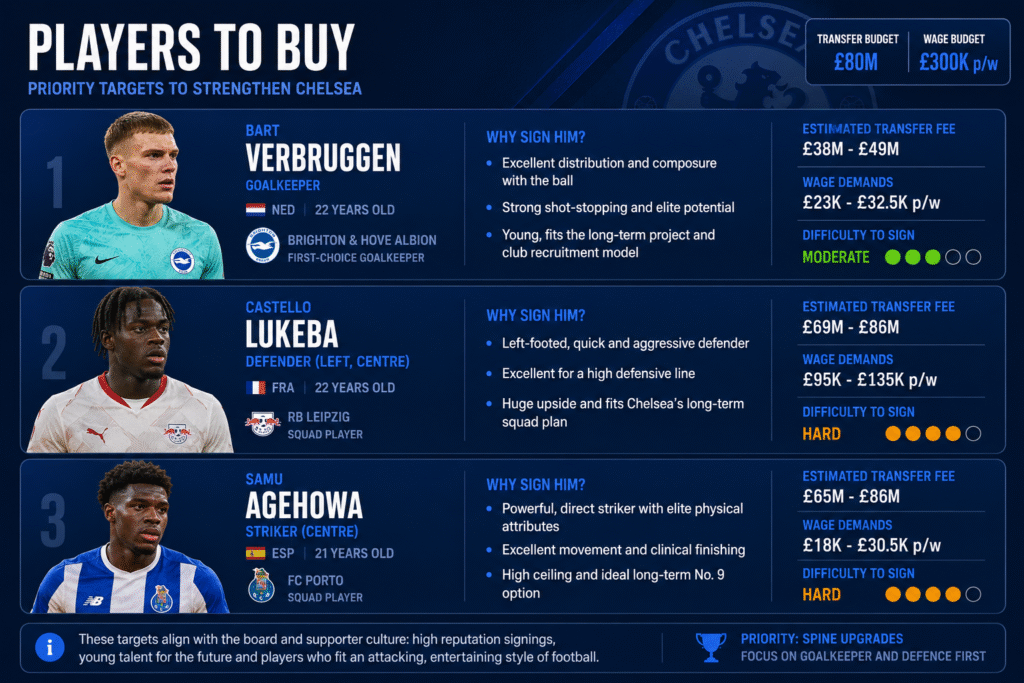
With roughly £80m in transfer budget and around £300k p/w available in wages, Chelsea can realistically make one marquee signing and potentially one or two additional smart additions.
Priority 1: Goalkeeper
This is the biggest weakness in the squad.
Robert Sánchez is capable physically but lacks the consistency, composure and elite distribution needed for a possession-based system. Filip Jörgensen has potential, but he still feels more like a long-term project than a title-winning number one.
If you want Chelsea to dominate games consistently, upgrading the goalkeeper transforms the entire team.
Diogo Costa – The dream signing.
Costa is elite with the ball at his feet, calm under pressure and outstanding in one-v-one situations. He immediately raises the ceiling of the team and fits perfectly with the high-possession system. He also has a buyout clause of £52m.
**Why he fits:**
– Elite distributor
– Comfortable sweeping behind a high line
– High reputation signing fans will love
– Long-term number one
**Potential issue:**
– On the expensive side considering you may need to keep Sanchez and Jorgensen
Bart Verguggen – The smarter value option.
Verbruggen develops into one of the best goalkeepers in FM26 and is slightly easier to structure financially. He also fits the BlueCo recruitment profile perfectly: young, technical and high potential. The only issue for a Chelsea fan will be going back to Brighton for another signing
**Why he fits:**
– Excellent long-term upside
– Strong distribution
– Younger profile – fits board culture
– More realistic financially
Priority 2: Left Sided Centre Back
Costello Lukeba – Probably the perfect BlueCo signing.
Young, athletic, aggressive and technically secure, Lukeba fits both the tactical system and the club culture objectives.
**Why he fits:**
– Left-footed
– Excellent recovery pace
– Aggressive defender for a high line
– Huge long-term upside
**Potential issue:**
Expensive
Jarrod Brainthwaite – The more Premier League-ready option.
Branthwaite brings physical dominance and aerial power while still fitting the age profile Chelsea want.
**Why he fits:**
– Elite physical profile
– Homegrown advantage
– Immediate starter potential
– Left-footed
**Potential issue:**
Everton usually demand big money but is singable for £45m
Priority 3: Striker
João Pedro suits the system well as a channel forward, but Chelsea still lack a truly dominant elite striker profile.
Liam Delap is useful physically but does not quite have the technical level to become a world-class first-choice striker.
Samu Agehowa – The high-upside option.
Massive physical presence, aggressive movement and huge development potential. He also has a buy out clause of £86m.
**Why he fits:**
– Perfect for transition moments
– Dominates physically
– Develops into elite striker
Gonçalo Ramos – more complete and reliable option.
Ramos offers pressing intensity, intelligent movement and consistency in front of goal.
**Why he fits:**
– Excellent off-ball movement
– Strong link-up play
– Fits aggressive pressing system
– Transfer listed – available for £86m
Chelsea FM26 Guide Long-Term Save Goals
Building Chelsea Back to the Top
Chelsea in FM26 is not a short-term rebuild. The squad is packed with talent, but there are clear structural issues, massive expectations and the constant pressure that comes with managing one of the biggest clubs in world football.
The challenge is balancing immediate success with the long-term vision of the BlueCo project — developing elite young talent, building squad value and creating a sustainable dynasty rather than chasing short-term fixes.
Your goal should not just be winning trophies. It should be building the best team in Europe.
Season 1 Goals
Stabilise the Club
The first season is about creating structure and identity.
Chelsea already have elite midfield foundations with Moisés Caicedo and Enzo Fernández, plus one of the best attacking creators in world football in Cole Palmer. The focus should be building a tactical system around them.
Main Objectives
- Secure Champions League qualification
- Establish a clear tactical identity
- Improve defensive stability
- Develop young players
- Begin phasing out weak links in the squad
- Reduce squad bloat
Key Development Targets
- Cole Palmer becomes the face of the project
- Caicedo develops into the best defensive midfielder in the world
- Reece James stays fit and becomes tactically central
- Mike Penders develops on loan
- Ryan Kavuma-McQueen and Reggie Walsh begin first-team integration
Season 2 Goals
Build a Title-Challenging Squad
Season two is where the real rebuild begins.
By this stage you should:
- Move on players who do not fit the long-term vision
- Upgrade goalkeeper and striker
- Integrate returning loan talent
- Improve depth at centre-back
- Push toward a Premier League title challenge
Key Squad Decisions
This is likely the point where players such as:
- Robert Sánchez
- Filip Jørgensen
- Liam Delap
- Nicholas Jackson
- Axel Disasi
- Datro Fofana
can realistically be sold for stronger fees.
Meanwhile, returning players such as:
- Aarón Anselmino
- Mike Penders
- Andrey Santos
should begin competing for major first-team roles.
Trophy Expectations
- Challenge for the Premier League
- Reach latter stages of the Champions League
- Win a domestic trophy
Season 3–5 Goals
Create a European Dynasty
The long-term aim should be creating a Chelsea side capable of dominating Europe for years.
By this point your squad should be built around:
- Palmer
- Caicedo
- Enzo
- James
- Penders
- Your elite striker signing
- Young Cobham talents
The ideal Chelsea side should combine:
- Elite technical quality
- Tactical flexibility
- Aggressive pressing
- High possession control
- Athleticism across the pitch
Long-Term Objectives
- Win the Premier League consistently
- Win the Champions League
- Build the best youth pipeline in England
- Develop world-class players internally
- Become the number one ranked club in Europe
- Create a squad with long-term financial sustainability
The BlueCo Challenge
One of the most interesting aspects of the Chelsea save is deciding how realistic you want to be.
Do you:
- Fully embrace the BlueCo model?
- Sign elite young talent with resale value?
- Build slowly and sustainably?
Or:
- Spend aggressively?
- Buy ready-made superstars?
- Chase immediate domination?
There is no wrong answer.
That balance between realism and Football Manager optimisation is what makes the Chelsea save so addictive.
Final Goal
The ultimate objective is simple: